High Electric Bill After Going Solar? How to Diagnose It
Went solar but your electric bill is still sky high? Learn how to read your bills and apps, spot metering issues, and track down hidden energy hogs at home.
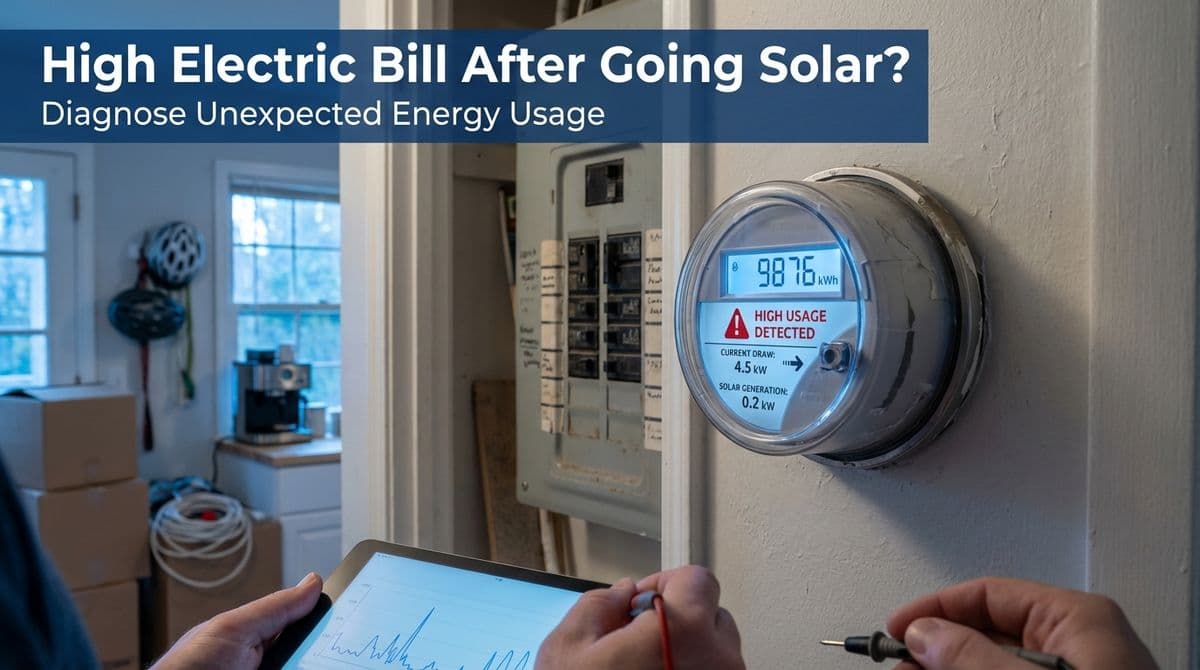
Why Your Electric Bill Is Still High After Going Solar
We recently got a call from a homeowner — let’s call him Mark — who was understandably frustrated. He had just invested in a new solar system, complete with monitoring through a Tesla app, and he expected his electric bill to drop like a rock.
Instead, it did the opposite.
Before solar, Mark’s home used about 400 kWh a month. After solar, his utility portal was suddenly showing around 2,800 kWh total usage when you combined what the solar was producing and what the utility said he was using. The solar company came out, said everything looked fine, and the app showed the system was working — but his bill was still “absurd,” as he put it.
That’s when he called us and asked, “Can you come out, check if the solar actually works, and help me figure out where all this electricity is going?”
Step 1: Understand What Your Bills and Apps Are Really Showing
On the phone with Mark, the first thing we did was walk through what data we actually had. Just like we told him, diagnosing a high bill after going solar starts with three numbers:
- Your utility bill (from Edison or your local provider) – how many kWh you pulled from the grid.
- Your solar monitoring app (Tesla, Enphase, SolarEdge, etc.) – how many kWh your solar produced.
- Your net usage – production minus what you still had to buy from the grid.
Most homeowners see one big number on the bill and think, “That’s what I used.” But with solar, you’re really looking at three flows:
- Solar energy you used directly in the home
- Solar energy you exported back to the grid
- Energy you still imported from the grid
When Mark said “solar only factors in one-third of my electricity use,” what he was seeing was that his solar app showed decent production, but the utility was still billing him a lot. That mismatch is your first clue that you need to dig deeper.
Step 2: Rule Out a Solar Production Problem
Before we assume you suddenly started using seven times more electricity, we always ask: Is the solar actually producing what it should?
Here’s what we recommended to Mark and what you can do at home:
- Check your app’s daily and monthly totals. Compare them to what your solar proposal originally estimated for this time of year. Big gap? That’s a solar issue.
- Look for obvious system alerts. Red warnings, offline inverters, repeated communication errors — these can mean only part of the array is working.
- Match the dates. Make sure you’re comparing the same billing period on your utility bill and in your solar app. Mismatched dates can make it look like something is wrong when it’s just timing.
In Mark’s case, the solar company had already inspected and the Tesla app showed the system online and producing. That made us look harder at the usage side of the equation.
Step 3: Compare Utility Meter Reads to Solar Production
This is where an electrician like us comes in. On the call, we explained to Mark that we’d send a tech out to:
- Pull readings from the utility meter (imports and, if applicable, exports)
- Pull readings from the solar system (via the Tesla app or inverter screen)
- Confirm those numbers line up with what’s on the bill
If your meter and app don’t agree, there could be:
- A metering configuration issue (for example, the solar isn’t tied in where the utility expects)
- A billing or rate plan mistake on the utility’s side
- An incorrect CT (current transformer) installation on systems that use consumption monitoring
Sometimes a simple wiring or configuration error can make your usage look way higher than it really is — or make the solar appear to offset less than it actually does.
Step 4: Hunt Down Unexpected Energy Hogs in the Home
Once we’re confident the metering is correct, the next question is the one Mark asked: “Where exactly in the house is all this electricity being used?”
Here are some of the usual suspects we look for during an in-home energy checkup:
- Electric resistance heat – space heaters, old electric furnaces, electric water heaters left on high, or heat strips in heat pumps.
- Always-on loads – pool pumps running all day, old refrigerators or freezers in the garage, well pumps, server equipment.
- HVAC issues – systems running constantly due to clogged filters, bad thermostats, or leaky ductwork.
- Hidden timers and controls – outdoor lighting, fountains, or equipment that was reprogrammed or left in “manual on.”
A professional can use clamp-on meters and circuit-by-circuit testing at your electrical panel to see which breakers are drawing the most power. From there, we trace that circuit to the actual devices in the home.
DIY Checks You Can Do Before Calling Us
If you want to start diagnosing on your own, try this:
- Turn off big loads one at a time (HVAC, water heater, pool pump) and watch your smart meter or usage monitor, if you have one.
- Walk the house at night and note everything that’s glowing, humming, or warm – especially in the garage or attic.
- Check runtimes on pool pumps, hot tubs, and well pumps; many can be safely reduced with timers.
If your usage drops significantly when one piece of equipment is turned off, you’ve found a major contributor.
Step 5: Get a Clear Report You Can Take Back to Your Solar Company
Mark specifically asked if we could generate a report so he could go back to his solar installer with facts instead of frustration. That’s exactly what a good energy audit plus electrical inspection should give you:
- A summary of solar production vs. utility imports
- A breakdown of which circuits are using the most power
- Any wiring or metering issues we found
- Actionable recommendations to reduce usage and improve the solar payoff
Sometimes the conclusion is, “Your solar is working, but your home’s usage has gone way up because of X.” Other times it’s, “The solar is underperforming or misconfigured, and here’s what needs to be fixed.” In either case, having hard data makes your conversations with the solar company and the utility much more productive.
Still Seeing a High Bill After Going Solar?
If your situation sounds anything like Mark’s — new solar system, healthy production on the app, but a bill that doesn’t make sense — it’s time to get a second set of eyes on the problem.
As licensed electricians, we can:
- Verify that your solar is tied into your electrical system correctly
- Compare real meter readings to what’s on your bill
- Track down unusual or hidden loads in your home
- Provide a clear, written report you can share with your solar provider
Solar should bring your bills down, not leave you scratching your head. If your electric usage numbers look “absurd,” you don’t have to guess why — we can help you find the answer.